.png)
British Phycological Society Annual Conference
By Sophie Wood, Programme Manager, UK Seaweed Network
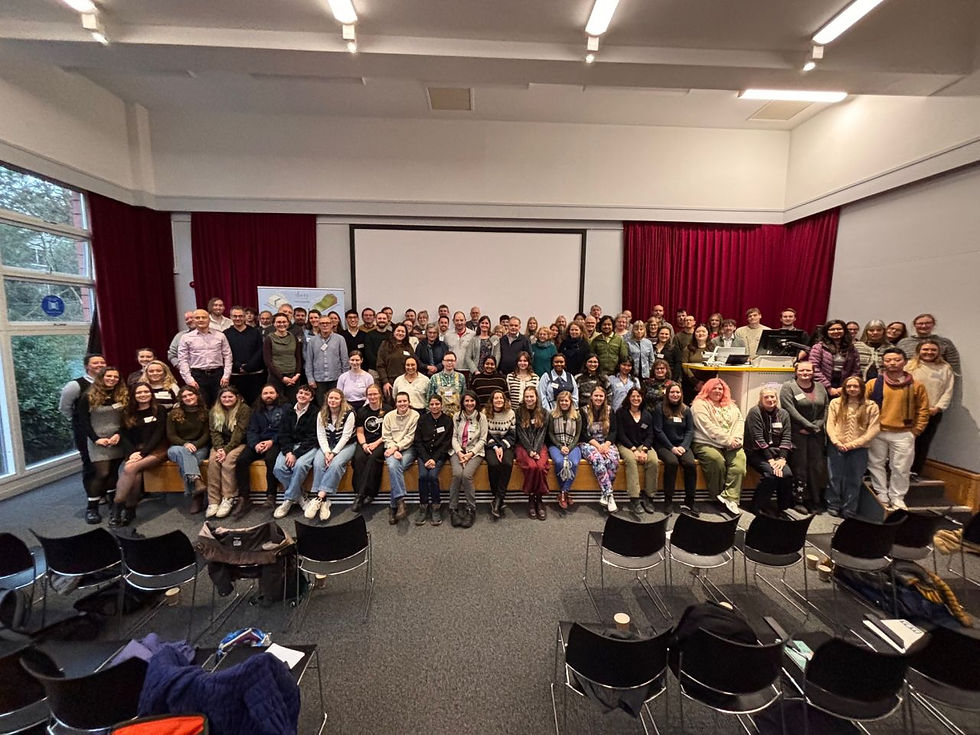
Last months’ British Phycological Society’s Annual Conference in Aberystwyth, Wales, provided three days of fascinating sessions, discussing research across micro- and macroalgae topics. This blog will focus on some of the presentations that covered macroalgae but worth a special mention is Svenja Heesch’s extremely entertaining session on Prasiolaceae and the green algal family’s love of high nutrient areas – if you know you know!

Manus Cunningham, from Queens University Belfast, presented his research into the cultivation of faster growing fucoids such as Fucus serratus and Fucus vesiculosis. There is already a market for these seaweeds and the aim of his research is to provide scientific evidence that facilitates cultivation of fucoids, in order to ease pressure on future demands for wild stock. His current experiment (which started in November 2024 and finishes March 2026) looks at how the cultivation start date, and the environment in which it is cultivated, impacts the growth, biochemistry and biological communities of F. serratus. Preliminary results showed a marked variance across the different cultivation environments. His next steps are to harvest the second half of his experiment In February and analyse the biochemistry of the harvest (including amino acids and carbohydrates). We look forward to hearing about his final results when published.
Two sessions, by Ben Jennings and Juliet Brodie from the Natural History Museum, focused on the monitoring of macroalgae and the global protection of seaweed ecosystems. Seaweed Breakthrough, an initiative under the Global Seaweed Superstar project, aims to increase the level of seaweed protection worldwide. Central to this work is improving our understanding of existing seaweed habitats by strengthening data collection and establishing meaningful baselines, while acknowledging that many ecosystems are already degraded. These benchmarks can then be used to set realistic global and regional protection targets, supporting the long-term restoration of seaweed ecosystems. (Juliet also highlighted the need to engage the general public through citizen/community science - more on education and outreach from Day Three is covered later in the blog).
While these presentations focused on monitoring and creating baselines on a global scale, they are equally relevant for the UK seaweed industry as it develops. It also relates to the vital work currently being undertaken by CEFAS to measure how much seaweed is produced in the UK – information that is actually a regulatory requirement. Without a baseline of what is currently being harvested and cultivated, it is hard to have a true picture of potential growth for the UK. It is also difficult to demonstrate to government that policy change is needed without specific data on what is currently being produced.
Also relevant to the UK Seaweed industry were a number of sessions that looked at the importance of the nursery stage in priming macroalgae for cultivation to increase resilience and performance. Research included looking at: optimizing different light spectrums (Rebecca McKinney from Queens University Belfast); increasing stress tolerance of sporophytes (Niko Steiner from HelmHoltz); the thermal adaptation of A. esculenta gametophytes (Reina Veenhof, SAMS) and heat treating gametophytes in order to understand the mechanism for observed changes and thereby helping fast-track adaptation (Puja Kumari from SAMS). Puja’s research was conducted using red seaweed (Bangia sp) but plans for future work to build on this research to help kelp breeding programmes and industry adaptation to climate change.
Another popular topic was the effect of macroalgae on wave attenuation. Jack Duffy, from Newcastle University, saw a significant reduction in wave height using Laminaria hyperborea mimics with medium and high densities of kelp canopy in his wave tank experiments. However, he also found that attenuation became less the deeper the water. Robyn Mastin-Wynne (Newcastle University) also presented on the role of kelp forests in attenuating waves but using in-situ experiments. She pointed out that there are only a few papers that look at this issue in-situ because of monitoring challenges and a lack of common methodology. Robyn also highlighted that all devices used for measuring are expensive and has developed a low-cost alternative, with the intention of making it open access. Jack and Robyn now plan to compare the wave tank and field data in order to ground-truth some of their findings.
Day two was kicked off by Rhianna Rees at our sister organization, Seaweed Scotland (formerly the Scottish Seaweed Industry Association – SSIA). As always, Rhianna provided an excellent overview of the seaweed industry in the UK, highlighting a number of challenges that the industry currently faces but also identifying opportunities for the sector.
This was then amply demonstrated through a presentation from Leon Williams at PlantSea about its pilot film rolls for packaging lines. The company fittingly started its journey into macroalgae bioplastics in Aberystwyth at AberInnovation. Leon shared some of the challenges that PlantSea faced in scaling up, particularly in terms of filtration. Plantsea now have proof of concept at a 500L scale, and their next step is to increase production to 10,000L. To date, they have been able to develop processes in the UK but, like many companies in this space, have had to turn to Europe to find infrastructure that enables further product scalability.
The final sessions of the conference, on Day Three, highlighted the crucial role of education and outreach in raising awareness of macroalgae and the many benefits that they can provide. This applies to the seaweed industry just as much as our academic colleagues in terms of engaging with the public, as demonstrated in presentations by Mikey Ross, from SAMS, and Dan Franklin, from BPS. They both emphasised that meaningful engagement is essential if seaweed and their ecosystems are to be better understood, valued, protected and utilised.
The importance of community-led projects was highlighted by Kirsti Davies of Gwymona, who demonstrated how local involvement can foster connection, stewardship and long-term impact. Echoing what Juliet Brodie had mentioned the day before around schemes like the Big Seaweed Search, Kirsti worked with her local community to foster interest in seaweed and its many uses. And Nikolas Kappas from HelmHoltz offered a practical tool for the general public to become more engaged and informed on seaweed: SeaKey aims to make seaweed identification more accessible, empowering both communities and researchers to engage more confidently with the marine environment.
There were also some interesting posters on display during the conference. Biostimulants are undoubtedly a focus for many in the UK seaweed industry at the moment and so worth a particular mention is Adam Reeve at the University of Plymouth, whose poster outlined his research on fermented macroalgal biostimulants and the effect on seed quality in Spring Wheat.
As much of the seaweed industry in the UK knows, one of the many challenges we face is the need for more UK-focused research into macroalgae across the supply chain, to support innovation and growth. As the BPS Annual Conference highlighted, extensive research is currently underway - the key is to ensure that that body of work is then available for application at a farm level. The BPS itself is acutely aware of this, running an applied phycology working group and the UK Seaweed Network looks forward to continued collaboration between academia and industry.

On a final note, UCL’s Policy Impact Unit and UK Seaweed Network took the opportunity to hold the third workshop immediately after the BPS Conference. Many stakeholders from across the UK seaweed industry braved Storm Goretti to contribute to conversations around manufacturing and technology, for which we are very grateful! As with the previous stakeholder engagement workshops, the report from the workshop will be available on the UK Seaweed Network website – coming soon!
We have two workshops remaining, one on Sustainability in April and one on Products and Markets in June. Do get in touch via contact@ukseaweed.org for more information.


Comments